

Κ.Σ. Μακέδη (2024) Εξερευνώντας το γλωσσικό τοπίο της “παιδικής χαράς”: Μια πολλαπλή μελέτη περίπτωσης στην πόλη του Βόλου.
Abstract
This research constitutes a multiple case study focusing on the Linguistic Landscape of
five playgrounds in the city of Volos. Specifically, it focuses on the ways in which
childhood is constructed through the “top-down” and “bottom-up” Linguistic
Landscape that appears in the playgrounds. Childhood is naturally a concept of
sociology and is a subject of negotiation in this research. Childhood will be analyzed
according to the postmodern definition, that is, as a social group perceived in
comparison to the social group of adults. From the various perspectives on Linguistic Landscape, this research adopts the view that the term Linguistic Landscape is
synonymous with the term Semiotic Landscape, which includes all semiotic resources
involved in the construction of meaning in a space (for example images, sounds,
smells). Data collection started on 09/01/2023 and ended on 30/09/2023 with nonparticipant field observation. During this period, 256 photographs were taken, 5 videos
(one from each playground), and 16 pages of field notes were recorded. The analysis of
these is thematic. The analysis revealed issues concerning the regulation of childhood
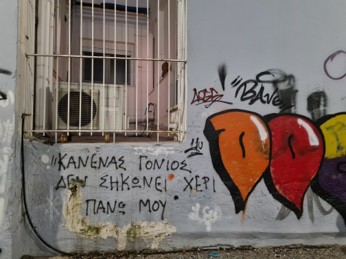
through institutional signs, the commentary on sociopolitical events through graffiti,
and direct references to childhood through graffiti once again. Through the institutional
Linguistic Landscape, childhood is constructed as Greek-speaking with specific age
limits, and entry to playgrounds is allowed only through various regulations and
prohibitions. In contrast, through graffiti, childhood is produced as a social group
without clear age boundaries.
You can read the entire thesis here.