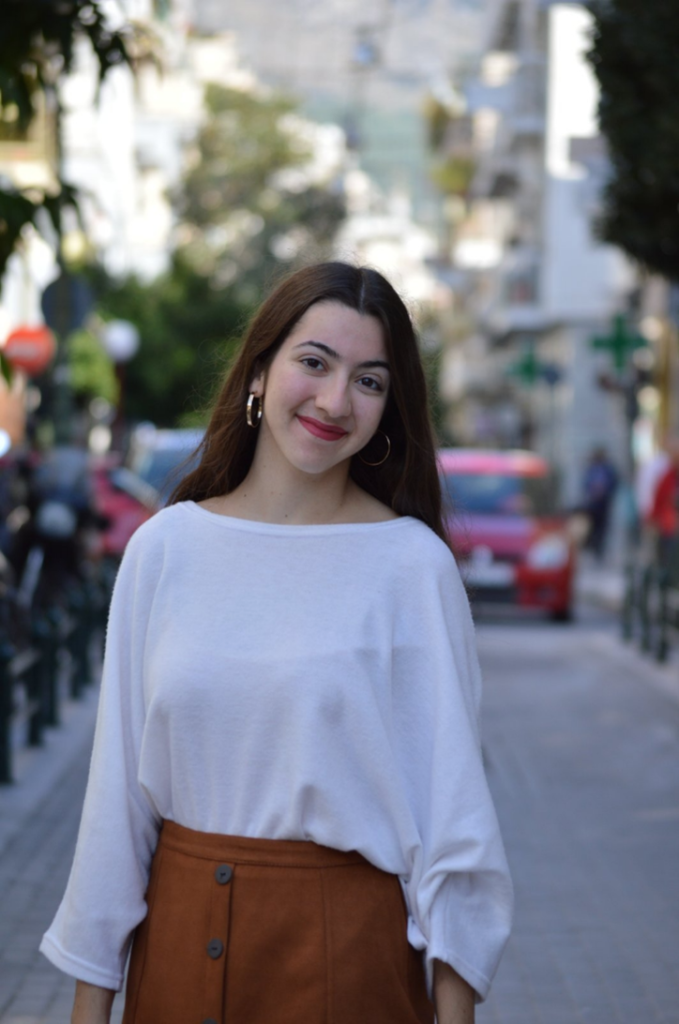
My name is Katerina Sfyraki, and I have been a member of the team since September 2023. I
grew up in Kilkis, and from a very early age, I remember seeking to understand the world
through words, images, and movement. Both journalistic and literary writing, photography,
and dance have always been ways for me to “translate” reality. The photographic eye
captures fragments of everyday life, poetic writing transforms them into inner landscapes,
and a research-oriented approach connects them to sociolinguistic and cultural perspectives.
Dance, a significant part of my life both in terms of time and even more so emotionally, has
given me a sense of bodily storytelling- the conviction that every movement can express what
is difficult to convey in words. All of these experiences came together in my studies at the
Department of Linguistic and Intercultural Studies in Volos. ound us. This academic journey brought me closer to fields that helped me understand that multilingualism and interculturality are not just theoretical concepts but complex landscapes- a mosaic of voices, meanings, and experiences reflected in urban environments and in people’s everyday stories. As a postgraduate student in the Interdepartmental Master’s Program “Tourism and Cultural Planning and Development”, I was immediately faced with a challenge: to bridge my
academic interests- two fields that, at first glance, seem unrelated- language and tourism. The
more I study them, however, the more I realize they share common roots: both are forms of
storytelling, ways of experiencing a place. Language captures memories, stories, and
identities, while tourism translates them into experience- making them accessible, vivid, and
tangible. I seek ways to combine research with practice: designing cultural experiences that
connect visitors with the city, its collective memory, and its living linguistic diversity.
Walking tours, for example, serve as such a vehicle: markings on walls and inscriptions
become verses, and the city itself transforms into text. My research engagement with the linguistic landscape of Volos, as well as my participation
in broader community-based projects through the team, has shown me that research is not a
distant act of observation but a dialogue with the community- a continuous disposition to
explore, a need to listen, see, and record; an invitation to reconsider the space around us.