

Romani Language Lessons
As mentioned in the “Identity & History” section, the Amalinoglossa group was created in the winter semester of 2024–2025, through the collaboration of the Volos Linguistic Landscape Research Group with our teacher Georgia Kalpazidou. Our goal was to create a co-learning group of Greek Romani, with an emphasis on both the language and the social and cultural contexts in which it appears or is absent.
In the courses, 8 of the 17 members of the Volos Linguistic Landscape Research Group participated as students, creating, together with our teacher, a group of Roma and non-Roma women, with different academic qualifications (graduates, postgraduate students, doctoral candidates and faculty member) and linguistic repertoires. Our first languages are mainly Romani and Greek, while we all know more than one language, with English in common.
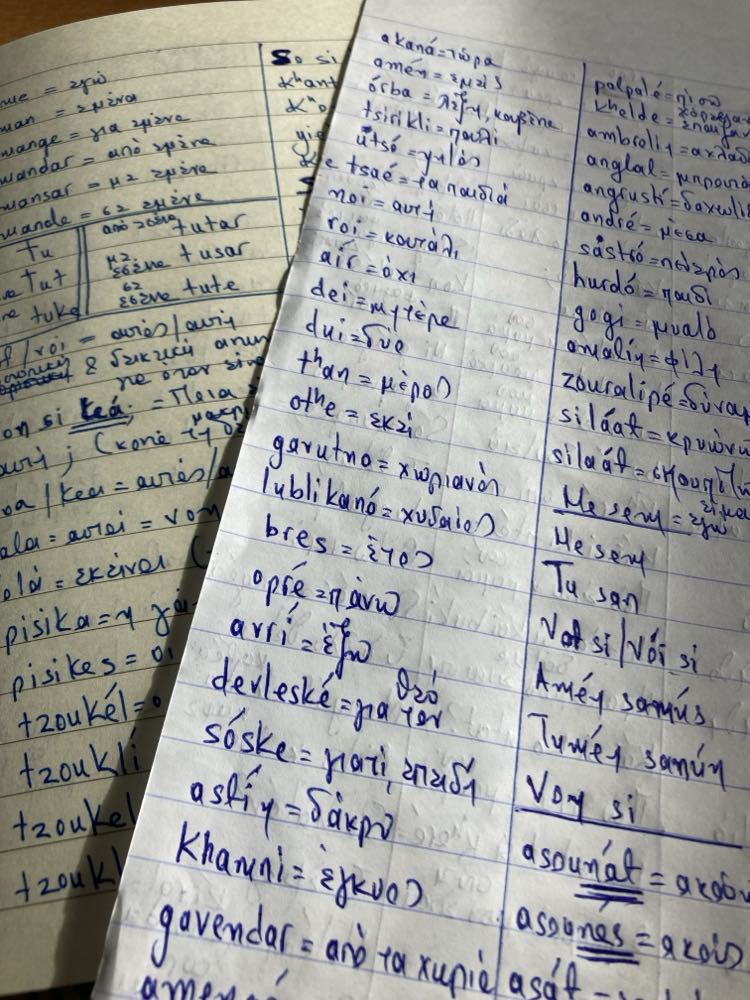
The learning process focused on the Arli dialect, as spoken in Dendropotamos, Thessaloniki, and was the starting point for our acquaintance with the Romani language and the culture of the Roma communities in the Greek context.
The structure of the courses
The courses took place over a period of four months, from October 2024 to January 2025. Our meetings took place every Friday, 11:00–13:00, online via the Google Meet platform. The group connected from different cities and countries [Volos, Thessaloniki, Athens and Tilburg (the Netherlands)], which strengthened the multi-lingual and inter-linguistic nature of the project. The main objective of the lessons was to learn the Arli dialect, but also to have a meaningful understanding of the culture Roma communities in Greece.
Thematic and pedagogical practices
The lesson program was not limited to grammar and the formation of the language. On the contrary, it was developed around a wide range of topics, which included:
- the history of Romani language and its basic features,
- different dialects,
- the culture of the Roma communities,
- the stereotypes and prejudices that accompany them,
- as well as social and educational concerns on multiple levels.
We started with an introduction to basic vocabulary and simple dialogues, utilizing the educational material that our teacher prepared for each meeting. The theoretical approach to the language was combined with translingual games, interactive practices and on-site practice, so that new knowledge could be applied immediately. Where necessary, additional emphasis and support was given outside of class.
Contact with Romani dialects
As part of the lessons, meetings were held with native speakers of different Romani dialects, who live and work in various regions of Greece. Through these meetings, we came into contact with the Florina dialect, Batsori in Athens and Vlacho-Gypsies in Alexandroupoli, gaining a more comprehensive picture of the linguistic diversity of Romani.
Documentary watching and group reflection
An important part of the lessons was the viewing of documentaries related to the Roma communities in Greece. The process included group documentary watching and collaborative reflection through discussions regarding what impressed us, what new questions arose, what we learned and how the content was connected to the lessons, new ideas and concerns.
At the same time, our teacher shared with us a wealth of supporting material, such as books, articles, dictionaries, posters, audio documents of different dialects, songs, poems, as well as useful links and websites, which strengthened both the learning process and our personal explorations.
Activities outside the “classroom”
The learning experience of the Amalinoglossa extended beyond the context of the lessons. For example, we participated in the presentation of Georgia Kalpazidou’s children’s fairy tale “Aerini m’ ena noi gia spathi” at the 10th Primary School of Aliveri, Nea Ionia (Volos). We watched the dramatization of the fairy tale through a theatrical performance made by the children of the 3rd Primary School and we participated in the activity for boundary setting through the construction of a kite together with the children. At the same time, we held discussions about future collaboration with the school and the Roma Branch of Aliveri.
Reflections and open questions
Our meetings were a space for constant reflection, which we continue to cultivate. Among other things, we discussed issues such as:
- Literacy → how do we write an oral language, so far? Do we use Latin, Greek or the international transcription alphabet?
- Right to education → accessibility / stereotypes and prejudices, what is really happening?
- Social exclusion and inclusion in the educational process
- Spreading Romani language without stigmatization → what can we do as Amalinoglossa group?
The Romani language lessons were for us a collective experience of co-learning, exchange of knowledge and ideas, discussion and redefining our relationship with multilingualism, translingualism, education, social and linguistic justice.